Wednesday, July 26, 2006

The Word of the Lord stands Forever


http://www.cnn.com/2006/WORLD/europe/07/25/ireland.psalms.ap/index.html


Psalm 83

A Song, a Psalm of Asaph.
1O God, do not remain quiet;
Do not be silent and, O God, do not be still.
2For behold, Your enemies make an uproar,
And those who hate You have exalted themselves.
3They make shrewd plans against Your people,
And conspire together against Your treasured ones.
4They have said, "Come, and let us wipe them out as a nation,
That the name of Israel be remembered no more."
5For they have conspired together with one mind;
Against You they make a covenant:
6The tents of Edom and the Ishmaelites,
Moab and the Hagrites;
7 Gebal and Ammon and Amalek,
Philistia with the inhabitants ofTyre;
8 Assyria also has joined with them;
They have become a help to the children of Lot. Selah.
9Deal with them as with Midian,
As with Sisera and Jabin at the torrent of Kishon,
10Who were destroyed at En-dor,
Who became as dung for the ground.
11Make their nobles like Oreb and Zeeb
And all their princes like Zebah and Zalmunna,
12Who said, "Let us possess for ourselves
The pastures of God."
13O my God, make them like the whirling dust,
Like chaff before the wind.
14Like fire that burns the forest
And like a flame that sets the mountains on fire,
15So pursue them with Your tempest
And terrify them with Your storm.
16 Fill their faces with dishonor,
That they may seek Your name, O LORD.
17Let them be ashamed and dismayed forever,
And let them be humiliated and perish,
18That they may know that You alone, whose name is the LORD,
Are the Most High over all the earth.

Monday, July 17, 2006

O Lord, it's Hard to be Humble...

I greatly appreciated the recent mullings of my friend Ben after he read A New Kind of Christian. In response to my (ridiculously long) review, he said that one of the helpful things that he came away with from McLaren's work was:

"Be humble about your interpretation of God's Word in light of historical theology. It is arrogant to think that any era "got it right," and yet every era, (including modernism) got some things right."

Indeed. Being humble about your interpretation of the Bible in light of those who have gone before is essential. In addition, one must apply humility to the right sort of thing. I like what Ed Stetzer (a pastor for
Mars Hill Church in Seattle) says about this, in light of the Word's innate authority:

"I have been captured by the term "humble orthodoxy." It well expresses my own understanding of the gospel—that I have a humble certainty that God and His word are true...True orthodoxy is not subject to the whims of cultural acceptability; it is humbly submitted to the word of God. It is not humble to question what scripture makes clear."

Add to this that it is the Word’s paradoxical combination of humble and lofty truths which makes its authority so compelling, as Augustine points out:

“…it seemed to me all the more right that the authority of Scripture should be respected and accepted with the purest faith, because while it can be read with ease, it also has a deeper meaning in which its great secrets are locked away. Its plain language and simple style make it accessible to everyone, and yet it absorbs the attention of the learned. By this means it gathers all men in the wide sweep of its net and some pass safely through the narrow mesh and come to you. They are not many, but they would be fewer still if it were not that this book stands out alone on so high a peak of authority and yet draws so great athrong in its holy humility” (Confessions, Book VI).

But how to “pass through the narrow mesh” and come to Him? By conforming our wills to the intangible concepts written down in His book? In part, yes. But it never remains in the abstract realm, comfortably contained on a sheet of paper. It always involves persons:

“Do nothing from selfishness or empty conceit, but with humility of mind regard one another as more important than yourselves….” (Philippians 2:3)

Whoa. This is the more daunting part for me –submitting to other human beings (who may be smart, stupid, bullheaded, more articulate, mean, or frustrating, depending on the day). That is, I live in a world populated with sinful humans like myself (some on the road to sanctification, some not), and I have devoted myself to the idea that I must be in humble dialogue with them in order to be a Christian. This will require more of me than doing my philosophical homework or cleverness of speech. It will take a terrific measure of grace.

As my old pastor used to say, “grace flows to the lowest place.”

I’ve got some hills to be made low.

Friday, July 14, 2006

The Emerging Church, Part II

A DIALOGUE. REALLY?

To begin, I'm not sure that postmodern thought (by this I mean deconstructionist theories, primarily articulated by Jacques Derrida, but others as well) has all that much to offer, even if we leave Christianity out of it for a moment. I could be dead wrong, but it seems as if its age is already waning in the academic arena, mainly because it's a system that internally contradicts itself, and therefore completely shuts down dialogue. Plenty of monologues going on, but what a conversation killer! And doesn’t scholarship consist of give-and-take? It would seem that postmodern thought is something of the proverbial party bore that won't let you get a word in edgewise. And people (scholars included) are getting tired of it.

But much is at stake here, particularly when we turn to Christianity thought, which also must include an element of discussion to thrive. Any attempt to destroy dialogue (whether by wielded sword or otherwise) has proven to be catastrophic and resulted in something that is no longer biblical Christianity. There are too many issues where the truth hangs in the balance betwixt two extremes for this not to be so. Sovereignty of God vs. free will of man, for one. (Of course, there is one Voice allowed total and complete monologue, which would be God, as you probably cleverly deduced from my Capitalization. He chooses to dialogue - through prayer, through His Word, and by sending His Son to preach the Kingdom. The difference between our "vertical" conversation with Him and the horizontal variety with our fellow human beings is that He can (and will, when necessary) tell us to shut up and listen. Witness His response to Job (38:2-4):

"Who is this that darkens my counsel with words without knowledge? Brace yourself like a man; I will question you, and you shall answer me.”

He holds complete and utter control of the conversation. He is God, after all.

Back to the book at hand. "A New Kind of Christian" appears to be in the form of a dialogue (subtitle: "A Tale of Two Friends on a Spiritual Journey"), and purports to exalt "conversations”. Sounds good on paper.

However.

The genre that the author has chosen to write about deep theological issues in (a non-fiction/fiction blend, with a dialogue between friends guiding the unfolding of ideas) ironically shuts down any kind of dialogue between HIS ideas and the READER'S. This is brought about for several reasons that I believe are completely intentional:

1) THE ROLE OF THE AUTHOR IS MADE UNCLEAR, as there are two figures who might be representing the point of view of the author, or they might not. This in turn makes the author's own ideas about deep theological issues that are discussed unclear, so the reader is disarmed and does not know how to respond. Imagine being on your cell phone to get directions to your friend's house, but (unbeknownst to you) it's actually two friends passing the phone back and forth, alternately giving you different directions to their respective homes. Sounds funny, perhaps. Now pretend you're trying to get to the hospital instead of a friend's house and the same thing is happening.

Not quite as amusing.

It's anything but responsible conversation, at least when it comes to hardcore issues, such as the veracity of the Bible, how people are brought into the Kingdom of God, etc. Certainly, there is a amount of play in conversation, as ideas are bounced hither and thither. In this book, however, I find myself stripped of my freedom to disagree with the author, because I'm not sure who he is and what he believes.

2) THE CHOICE OF GENRE - what is it, exactly? I'm not hammering on McLaren's use of fiction, which has certainly been used to accurately and beautifully represent deep theological truths. (C.S. Lewis would be the elephant in the room on this one, though I'm thinking also of Charles Williams, G.K. Chesterton, maybe Tolkien, though he himself would object). Two of these writers use the tool of allegory. A coincidence? Probably not, because they were both medieval literature specialists. Williams and Chesterton were not, however, and yet they do have fantastical, allegorical imagery, albeit "mixed up" with "real life" kind of people and scenes. They were consciously playing around with genre and (perhaps not-so-consciously) pioneering magical realism.

So, what is McLaren doing?

He would seem to explain himself in the introduction, in which he says that he has consciously chosen the dialogue format for the same reasons that Galileo did, whom he cites: "I have thought it most appropriate to explain these concepts in the form of dialogues, which, not being restricted to the rigorous observance of mathematical laws, make room also for digressions, which are sometimes no less interesting than the principal argument."

Cool. Digressions. I can handle that. But Galileo's were built around a "principal argument" at least. What's McLaren's argument?

3) THERE IS NO CLEAR ARGUMENT. This is a direct result of the first two observations (UNCLEAR AUTHOR, UNCLEAR GENRE). Everything is digressions. There is no central, unifying idea - because that would fly in the face of the postmodern project, whose rules McLaren is trying to abide by. We must have a thousand little stories, because we cannot give preference to one strong, central storyline. And I'd like to repeat here that this means his readers are not free to embrace or reject or even dialogue with his ideas.

I have a wry smile right now, because of course I'm dialoguing with them, even as I write this sentence. I suspect that there are many people that read this book who, like me, do not fit neatly into one of two categories that he seems to want to impose on his readership:

1) Disapproving members of evangelical Christianity embittered by his ideas
2) Sympathetic, closet-lovers of similar ideas to the author – the “I thought I was the only one” variety

Because I cannot see myself in either extreme, it makes for one slippery grasp I’ve got on his ideas. Still, let’s have a go at interacting with a few thoughts.

VIEWS ON THE BIBLE

Aptly named “Hot Words about Biblical Interpretation”, the sixth chapter recounts how “Dan” displays a considerable amount of ire regarding how his friend “Neo” approaches the Scriptures. We know, of course, that it’s all an act – he’s trying to relate to his readership, and so appears sympathetic to their situation, thus winning them over. It’s a textbook rhetorical tool that has been celebrated from classical (and thus, also Renaissance) literature. You can’t fault the guy for being so cunning – but it seems a little hypocritical to insist that you’re not here for a debate, and then go ahead and use the snakiest tool in the bucket.

Anyway. I digress. (You see, it’s rubbing off on me. ) The first bone I have to pick with this chapter is that McLaren advocates (thorough his character Neo) that cutting the "analytical" part out of Bible reading is okay, even essential for Christianity to grow. My point of view would be: there are many ways of reading, and all are good spiritual exercises for the Christian - whether it's approaching it from the "scholarly" point of view that Neo wants to do away with, or whether it's exercising our imaginations, letting God's word "play upon us" as Neo says - what Christians for thousands of years call "meditation on God's word". Both (and others) are essential to a rich Christian walk. I also don't know what he means about "our modern approaches aren't working very well" (58). I rejoice in the imaginative and rigorous work of a good many recent authors and lecturers.

Secondly, it seems reductionist to call the Bible our "family story". Neo harps on the fact that. "we moderns" want it to be God's encyclopedia. This is only marginally accurate, if I’m remembering my history aright – the use of the Bible to teach astronomy, poetry, physics, etc., is much more a framework from the Middle Ages than the modern age, which was distancing itself from religion (Cf. Beryl Smalley's Story of the Bible in the Middle Ages).

Thirdly, I disagree with McLaren’s devaluing of Biblical authority by decentralizing it from the actual historical object itself:

“The real authority does not lie in the text itself, in the ink on paper, which is always open to misinterpretation- sometimes, history tells us, horrific and dangerous misinterpretation. Instead, the real authority lies in God, who is there behind the text or beyond it, or above it...”

Er...somethin’. Wait, how is it that the ink on paper is more open to interpretation than the idea behind it? This is, after all, what written records are for – to preserve more accurately for a longer period of time than oral record could. Why else so much hubbub when the physical representation of God’s commands are unearthed in Kings, resulting in delightful, humble praise?

I’m sure if I pressed, McLaren would agree that it is important that God chose His Word to be physically preserved by the languages Greek and Hebrew originally, with the intent of having humans translate them over time for every tribe, tongue and nation. He willed that it should be preserved on ink and paper, through the imperfect yet faithful tool of the Church (such as monasteries in the Middle Ages as documented in the excellent “How the Irish Saved Civilization” by Thomas Cahill). But if He could do all that, couldn’t he SOMEHOW intrepidly get us through the interpretatively dangerous waters of modernity? Heavens, does our faith in God’s sovereignty drop off when we enter the modern era?

VIEWS ON CULTURE

First of all, "Neo" uses C.S. Lewis' The Discarded Image in a way that Lewis himself probably never intended. Mclaren recounts one of Neo’s lectures, in which he uses many wonderful passages from this book, which is Lewis' "Introduction to Medieval and Renaissance Literature". That's the subtitle. It's not: "guide for a new generation of Christians wrestling with worldviews". Its purpose is as a guide for students of medieval and renaissance literature learning how to step back into another era's framework of understanding IN ORDER TO UNDERSTAND THE LITERATURE. I'm sure if this difference in intent makes it a wrongful use of his book, but I'm inclined at first to think so.

Regardless, McLaren is basically bumping up against the eternal question of Christianity and culture; that is, how much should culture invade faith and vice versa. A classic example of this is how much should missionaries cater to the culture that they are bringing the gospel to – must they insist that they change their music, their clothing, their seasonal rituals....? Like the early church in Acts puzzling over the place of Jewish dietary laws, we must weigh what measures up to Christ’s definitions of the Church. Though generational and not geographical, I would treat the postmodern culture in the same way – whose quirks are no more or less bewildering than the whether to eat meat sacrificed to idols question! How do these beliefs and practices look next to the truth of God? Inconsequential? “Permissible but not edifying”? In line? Out of line?

See, I’m all for looking for biblical ways to communicate with this generation in languages they understand. But, where I part ways with this book is in the seemingly wholesale adoption of postmodern constructs - it is troublesome to me that truth-undermining deconstructions are expected to hold up the “weight of glory” that has been celebrated through affirmations, certainties, and creeds of faith throughout the centuries. Not only does postmodern philosophical system make conversation difficult (my relatively minor complaint from earlier), it undermines absolutes that God has set in place. One thing that IS good from the modernist framework which we SHOULDN’T throw out is the idea of certainty. This was one road from that era that ran somewhat parallel with biblical thought that ought not to be tossed out just because it’s guilty by association. When founded on the truths of God and balanced out with a proper humility, it also happens to be biblical!

There is some inconsistency in the author’s complaints about being “modern”, however. In the sixth chapter, Neo warns “Dan” against using outmoded modern frameworks for understanding the world. Yet he uses the modern labels "conservative" and "liberal" right and left (no pun intended), and trans-historically applies them to other eras of history willy-nilly. For example, he talks about "conservative Christians" who advocated slavery. Yes, there was overlap between churchgoers and slave owners – a horrific chapter in the troubled relationship between Christianity and culture. Whether these evil men can be called "conservative" or "Christian" on our terms is hard to say. (On a side note, it seems singularly unfair to conflate political conservatism with Christianity, because they are NOT faithful bedfellows – not in this century, nor any other.)

No decent book review should ever...be this long. But it also shouldn’t leave out one essential category. (I am truly sorry that this section is disproportionately shorter than the first “half”.)

WHAT I LIKED

In the last chapter, "Notes on Church Leadership", the book switches to a dialogue between Neo and a young mentor, Casey B. I find a good deal to appreciate in Neo's portraits of an ideal "seminary".

1) He is wide open to creative expressions of Christianity (dance, crafts, Web pages, movies, whatever). This hits on a pet issue of mine, which is the expression of Christianity through the arts, which is way overdue for a rebirth in the church.
2) He wants to restore the community aspect to the seminary (living, cooking, eating, studying, working together). Stellar idea.
3) He wants seminary students (and presumably every Christian) to study worldviews from all eras, especially historical theology, and make sense of their own time and the models in place. I think of the phrase "knowing their times", like Daniel and his friends.

The church is certainly in need of a reawakening - I am not disputing that. But God's purpose in revival does not strike me as shaking off the bonds of our previous generation's worldview. (This has been a byproduct of revival at times, perhaps, but not the main point.) To achieve the goal of "disembedding" ourselves from the previous model, McLaren finds it necessary to single out modernity as the scapegoat. For example, he is anxious to restore beautiful relics of older models, such as liturgy, and yet he cannot handle any concepts that vaguely relate to or resemble something from the modern era, even if they are redeemable. This attitude seems counterproductive to the author's stated aims of understanding all models as valid backdrops to Christianity. Yes, much of the current-day church is infected by ideas from our times that are inimical to the Bible (such as consumerism to the point of selfishness and a general abandonment of generosity towards the poor). But there is much to be thankful for, too. (Um...can anyone say Reformation?)

McLaren's characters keep insisting that we go back to the Bible for answers. This is healthy and good. I hope they keep it up. It should guard us from faddish ideas.

Finally, McLaren’s honesty and his candidness about his struggles are admirable. In that same spirit, I would like to conclude by saying that a few things that bugged me about his thinking actually ended up serving as a mirror into my own life. For example, given the historic extremes of legalism and license in the Christian life, he seems over-eager to paint the picture of the “cool” Christian – the one that knows how to relax with a few friends, have a few beers, whatever. I’m all for enjoying the things of this life – but I don’t need MORE attention drawn towards them. They’re sparkly enough on their own. Frankly, I just need some good ol’ fashioned instruction on how to delight in God’s Word, and pray, and love people. “All these other things will be added”.


------------------------

P.S. Many thanks to Sara Dick for pointing out the Desiring God Ministries conference website, which features a bunch of videos from Mark Driscoll, John Piper, and other helpful people about the emergent church movement. They're mainly just snippets to give an idea for what the conference is about, but incredibly solid, clarifying, and thought-provoking. Check them out:

http://www.desiringgod.org/news_events/dgm_national/2006/videos.html
Thursday, July 06, 2006

Watch out - the Church is Emerging!!!


After Bob DeWaay published a thorough review of Brian McLaren's A Generous Orthodoxy, this Twin Cities minister became something of a lightening rod in the going debate about the emergent church movement. A group of friends and I attended a public debate between DeWaay and Doug Pagitt, who is a pastor of a local emergent church and also a major coordinator citywide for the movement. DeWaay's position might be summed up in the following statement he writes about McClaren's method:

"His purpose is not to tell us what is true or false about propositional statements regarding God, man, salvation, and eternity; but to stimulate our thinking by purposely promoting obscurity."

And sure enough, McClaren states:

"Shock, obscurity, playfulness, and intrigue (carefully articulated) often stimulate more thought than clarity."

Unfortunately, up until this point, I have only read bits and pieces of writers (goodness knows how much out of context) from both sides of the issue. Here's a couple more, on one of the touchier subjects - the epistemolgical question of certainty of knowledge:

"How do "I" know the Bible is always right? And if "I" am sophisticated enough to realize that I know nothing of the Bible without my own involvement via interpretation, I’ll also ask how I know which school, method, or technique of biblical interpretation is right. What makes a "good" interpretation good? And if an appeal is made to a written standard (book, doctrinal statement, etc.) or to common sense or to "scholarly principles of interpretation," the same pesky "I" who liberated us from the authority of the church will ask, "Who sets the standard? Whose common sense? Which scholars and why? Don’t all these appeals to authorities and principles outside the Bible actually undermine the claim of ultimate biblical authority? Aren’t they just the new pope?"

DeWaay might counter with the following type of repartee:

"God holds us accountable for the knowledge we have. The postmodern view of the hopelessness of knowing the truth flies in the face of the Biblical claims that God will judge us and hold us accountable if we suppress the truth."

Simple, straightforward, to the point, and biblical. Kind of simplistic, though. This was his main fallback position during the debate- simply to emphasize propositional logic, which wore thin pretty fast, given what was at stake. It's not the (however useful) tool of logic that we ought to be ultimately defending. There is more at stake her - i.e. ABSOLUTE TRUTH. The propositional system of logic may reflect the nature of the One True God and also be a useful conveyor of truth to a human mind. But it is not the most profound truth - the "deepest magic", as Aslan might say. Our thoughts are not His thoughts, nor our ways His ways, as Isaiah says. At any rate, it's about time that I stop quoting these things out of context and swallow something whole. To that end, I am borrowing a friend's copy of McClaren's "A New Kind of Christian" and I will be reading it over the next few weeks. This will perhaps give me something more solid to contribute to the conversation.

Being in the French Department of the U, I wrestle with the interaction between current cultural trends and my Christianity on a daily basis. For me, the tenets of deconstructionism are nauseating and stimulating by turns. While it is true that we need to build bridges in order to talk intelligently with others about how our faith interacts with postmodernity, Bible-believing Christians must guard against crossing those bridges. Foucault, Derrida, and other French thinkers have sent out their roots into many areas, and it is my conviction that the emergent church might be fertile ground for them - to its detriment.

My initial reaction to the emergent church (and I am happy to be wrong, if I discover something different along the way) that it is a textbook postmodern modification of Christian hedonism. That is, you can rejoice in the beauties of God, but you are not bound to believe in the absolute truths corresponding to those beauties. This is no new heresy to combat against but (true to form) a piecemeal collection of various and sundry fringe items from early Christianity to the present day. You have the extreme universalism reminiscent of the great novelist Madeleine L'Engle, the social gospel from many eras, and certainly an exaggerated emphasis on mysticism. It really amused me when I found out that Mclaren equated his open-mindedness towards poets with that of Chesterton's. I can't help but imagine that G.K.C. would find this idea nothing but pure silliness.

On the other hand, we have nervous clergy like DeWaay who are struck with a severe case of
mystiphobia; some of McClaren's descriptions of God's creation that I find imaginative yet orthodox creep him out as heretical. Who with a poet soul has not had exhilirating spiritual experiences? Of course, placing such experiences IN PLACE OF the written word offers a very seductive theology for those who love beauty. For this reason, DeWaay dismisses anyone remotely in the mystical tradition - Richard Foster, for example, whose book "Celebration of Discipline" offers a joyous and balanced view of the classic Christian disciplines - including Bible reading, memorizing, and meditation-in the Quaker tradition. Dear me! Let's not throw out the baby with the bathwater. -----------------------------------------------------------------------------------------

References:
Bob DeWaay's review of McClaren: http://cicministry.org/commentary/issue87.htm


Friday, June 30, 2006

Re-creation


A few years ago, while out for a morning jog, I briefly caught a conversation between a toddler and his mommy pushing him in a stroller:

-(Pointing to me) "What's she doin'?"
-"Running, dear."
-"Why?"

I remember chuckling ruefully at the time. However, I've in fact been bothered of late by the same question. Why are we so attached to sports or physical activity - i.e. recreation? Why the World Cup? Why pickup baskball games in the park? Why hundreds of people running around every weekend in seemingly futile circles around Lake Calhoun, Isles, Harriet, etc.? Why swimming, sailing, kayaking, golfing (SERIOUSLY), hiking, biking, canoeing...

Much could be said about pride and the search for prestige, especially in the more visible sports. But these are the most obvious answers. I'm gonna place my bets elsewhere, just for argument's sake. What other motives might there be? (My mind is filling up with images of "special stories" from Olympic coverage of years passed, when we see the young, brave athlete strapping on their skates for the umpteenth time...)

I don't want this to get corny.

But something DID strike me recently that I've got to throw out there. While joggin' and sloggin' along through the summer heat recently ("why?!"), I realized that in re-creation, we re-create ourselves in a way. Give me a second to explain. In this world, we all yearn for new bodies. No one is exempt from this. For the Christian, one of our dearest hopes and convictions is that when the Lord returns, our bodies will be resurrected and NEW. This is essential to the Christian for their ability to withstand the glory of God. As the downcast Job explains:

A. Life sucks. REALLY sucks. But -
B. "As for me, my Redeemer lives. Even after my skin is destroyed, YET FROM MY FLESH I SHALL SEE GOD." (Job 19:25)

This "flesh" can only be the resurrected body, because the old body is "destroyed". Paul invites us not to speculate overmuch, but we do know that it will be modeled after the design of the body of the resurrected Christ - "we shall all be changed." (1 Cor 15:51)

But what the heck does all this theology have to do with sports & stuff?

Here's the deal. I'm seeing that our desires to shape and tone and firm up and strengthen - these are all God-given desires, because we want our new bodies SO BADLY. When coupled with the communal, competetive, and other aspects of sports, the urge to partcipate really takes over, for some people. (You'll know what I mean if you're that kind of person.) But I'm ready to postulate (oh dear) that the desire for our resurrected bodies is the PRIMARY MOTIVATOR. I'll be happy to discuss with anyone who feels the contrary. I'm particularly interested in what y'all think about the legitimacy of searching for a new, toned earthly body if a heavenly one is on the way. Are all of our sweaty efforts in vain? What purpose do they serve towards our eternal life?

Wednesday, June 21, 2006

New York, New York!


Okay, I am finally getting around to posting about our lovely voyage to the Big Apple. With only 3-4 days to explore such a vast city (for the very first time for both of us), we had to set some priorities. Considering the shared predispositions of the Cox and von Gohren family, two main objectives began to emerge:

1. Eat well.
2. Hear live music.

And did we ever! Follow the link below:

New York Slideshow

Ever take it off any sweet jumps?

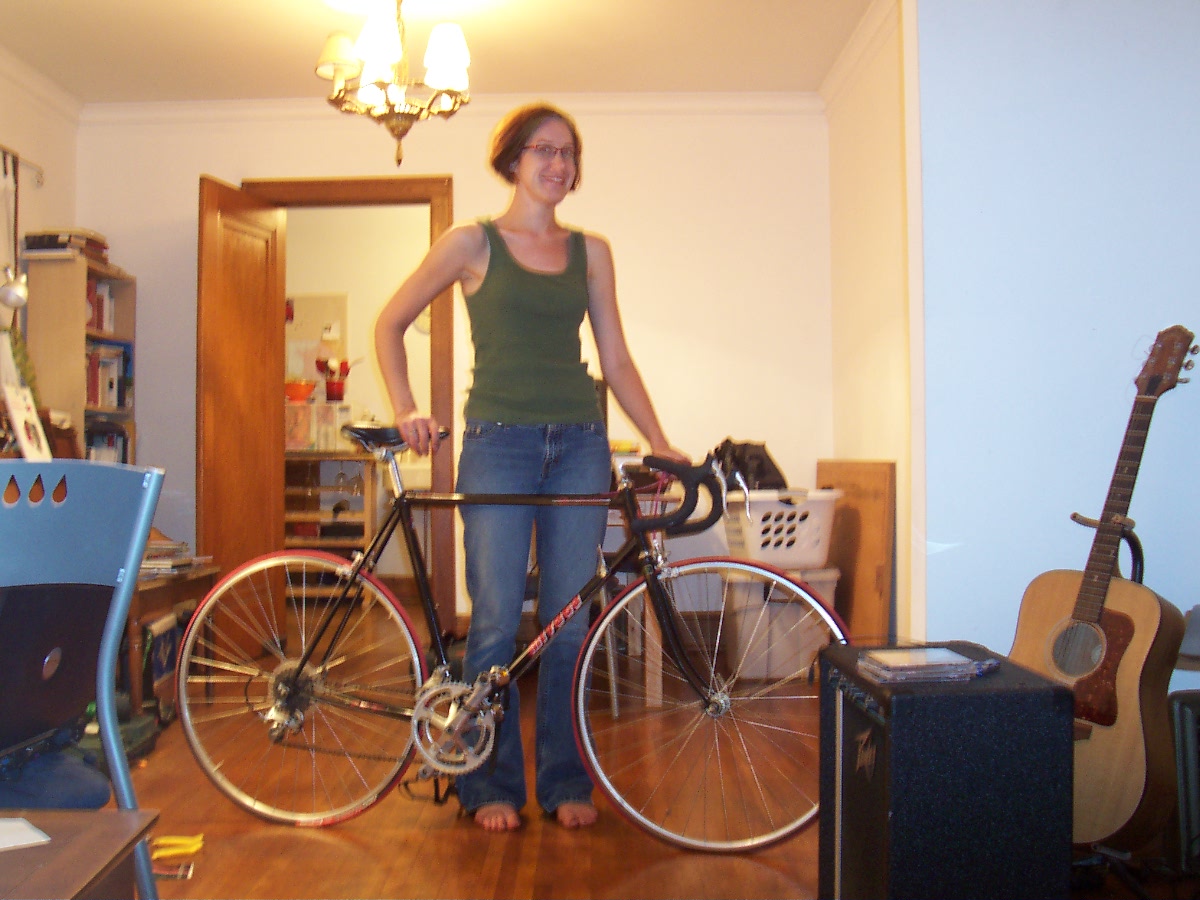
I've got a new ride. Karl decided that Abbey could have his old bike, provided that he refurbished it a tad. Isn't it good-looking? Oh wait...that's the mechanic. Hang on a sec.....


Before............................ and After......


Now, navigating the Parisian streets might be a whole different matter. My new bright red wheels (which you can't see in the picture) might make me a bit more obvious than normal.


Anyone wanna go for a spin?

Thursday, June 15, 2006

Restless Thoughts

Thanks to a top-notch discussion by Bill Edgar, I've been re-launched into thoughts on Sabbath rest. Take my advice and carve out an hour of your life to listen to this lecture. What he says about our culture and life on earth is so TRUE and GOOD. Just click on the link below:

A Theology of Entertainment

Edgar talks about what Pascal calls the diversionary life, an existance in which everything is engineered to foster our discontent. Pascal posits that all evils stem from our inability to stay at home; that is, our propensity to wander. For him, to err in the moral sense and the physical sense are inextricably linked. I am not willing to completely buy into that argument. While I agree that human nature has always been restless - "till we find our rest in Him" (dear old Augustine) - I think the urge to physically wander can certainly be a symptom of (or metaphor for) spiritual unrest, but it might just be an evening walk to strech your legs. It could be both (cf. Jacob's tussle with an angel after a midnight stroll).

What is so extraordinary about Pascal's thoughts in this area ("Pensees"), is how prophetic they were. His observations seem much more akin to the problems of our day than anything I can imagine from his. From blogs to cell phones, multiple email addresses to TV, ads to US Weekly... the means of diversion stretch on ad infinitum. As Bill Edgar points out, the irony of these recent technological developments is that they are supposedly for COMMUNICATION'S sake, and yet they seem rather to hinder profound, or even decent conversations between people.

And you know, he's right. In order to aside the time to talk with a friend over a glass of wine, our busy schedules force us to play "phone tag" - one of the saddest forms of non-communication around - in which we achieve no personal connection whatsoever, talking to one another's machines, hoping against hope that we'll somehow "connect" at some point. Technology is replacing humans at a frightening pace...


...Mwahahaha!

Ok. Settle down, Abbey. Technological advances are NOT evil. (This is perhaps the mistaken conclusion of Aldous Huxley's Brave New World? Maybe.) All the same, it follows that if Pascal was able to observe the dangers of restlessness, despite the fact that he did not have a blog to update, twenty emails to respond to, and his cell phone vibrating off the hook, then we indeed have a transhistorical problem on our bloody hands.

T.S. Eliot aptly describes the unhappy state of restlessness as:


Neither plenitude nor vacancy. Only a flicker
Over the strained time-ridden faces
Distracted from distraction by distraction
Filled with fancies and empty of meaning
Tumid apathy with no concentration
Men and bits of paper, whirled by the cold wind
That blows before and after time,
Wind in and out of unwholesome lungs

"Distracted from distraction by distraction." From one TV show repeat to the next to the next. From one single-shot skinny latte to the next to the next. That's the bummer about diversion - we end up stuck in that cycle of semi-escape where nothing meaningful will do. We prefer apathetic fancies to meaning and concentration. No wonder we're always bored. Like C.S. Lewis says, we prefer making mud pies in our backyard, because we cannot imagine what a holiday at the beach means. What will save us from our endless diversionary mud pies?

Rest.

Now, what THAT means remains to be unpacked.


Sunday, June 11, 2006

Cabin Days...


This weekend, Christa and Tim hosted us at their beautiful family cabin on Lake Wissota. Apparently this lake is referenced in the movie Titanic (though I make it a point of pride never to have seen this film) by the Leonardo Dicaprio character, who claims to have ice fished with his grandfather on this lake wheh he was a little boy. There's only one problem.

Lake Wissota didn't exist at the time of the Titanic. It is a manmade lake, constructed in 1917, 5 years after the ship went down. This is duly noted the highly-authoritative Wikipedia, but even more importantly, told to me with great ardor by my new cousin Tim.


Despite these historical discrepancies, the lake was quite real and quite chilly, as the boys (and a few girls from time to time) braved the waves. Tim and Karl became quite adept at switching inner tubes mid-ride, making for some awkward yet triumphant moments.....


It was summer at its best...cold beers in the late afternoon sun, taking the motor boat to the roadside stand for cheese curds and root beer floats, women circlin' up for a rollicking night of cards while the guys did...something...with....guns Good things.


The elegant Mrs. Thaler


Natalie and Hayden (right),
the youngest crew member

Monday, June 05, 2006

Shameless Plug for my Husband's Band

That phantasmagorical extravaganza of talent known as...


will be kickin' it up on the East Side on June 16th, at Minnesota Music Cafe. Promises to be a night of dancin' and schmancin'. But mostly good music. Come see your favorite keyboard player and mine astonish the crowd with his meaty chops.

www.aryastone.com

Wednesday, May 31, 2006

Birthday! Cubed!


Yes, Abbey is twenty-seven years old today. That's three to the third power, or cubed. It's hip to be square. I'm the same number as a rubik's cube! Sweet.

Yesterday was awfully busy. Slept in...quick church...whew...pack a lunch, we've got a wedding to go to (by the way, there's a work meeting, too)...should we hang out with the cousins afterwards...no....maybe...wait, weren't Sundays a day of rest in some bygone religious tradition?

They say that literal Sabbath rest is a symbol and shadow of the spiritual rest in Christ. If I rigorously apply myself to observing the literal, does this magnify or nullify the spiritual? Still, practically speaking, we all need rest. I guess this could take different forms, but rushing from one event to the next seems intrinsically imcompatible with any sort of "down time" No wonder we all complain about "needing a vacation" so often. If we had a proper weekly vacation, we might last a little longer. We might even get a longer life span out of the deal. I wonder if anyone's done a study on that...a Sabbath study.

Keeping the Lord's day. A fountain of youth. Something to think about as I turn a year older.

Monday, May 29, 2006

Abbey's New Health Club Membership

My health club membership costs me anywhere from $30-$45 every year or so. My fees were due yesterday. The facilities are quite nice, as you'll see from the photos below:


Oh, and they throw in access to the exercise room for free:


Okay, yeah. I'm too cheap for a REAL gym. But a pair of sweet new Sauconys plus the open road outside my door, that'll do me just fine.

Of course, it isn't cool and crisp right now, as this photo of dear Minnehaha Trail would suggest. My grand retour to running has been nothing but hot and muggy, so much so that I feel like throwing on a pair of goggles and a swim cap and swimming through the air. Still, I somehow prefer it to a treadmill. Call me crazy.

Friday, May 26, 2006

169 Avenue de Choisy

This is the "balcon" of our future apartment near the Place d'Italie in Paris, France. What better place, conflation of all things French and Italian, with Chinatown nearby with its bubble tea joints and cheap Vietnamese eats? Not only that, the apartment faces southwest. This marvel bears repeating. IT FACES SOUTHWEST. Avenue de Choisy. Even the name sounds charming.

There's a lot of work to be done before we can sigh and collapse contentedly onto the tiny little couch in the tiny living room.

All the same, feel free to come on over for a cup o' coffee. Or a glass of wine, depending on the hour. We'll be here anytime from early September to late June, ready to pour.

Thursday, May 11, 2006

Moonwalking

We went for a walk last night. The sun was going down, but the moon was already so bright, you could hardly look at it. A paper-punch hole (not quite perfectly round) with piercing white-light blazing through. On the other side of the sky, all sorts of crazy colors, which interacted with Lake Hiawatha, slipping around in oily dips of light. Yes, the sky - there was this patch of orange that looked so enormous, it could have been a continent. I don't think I've ever seen that color anywhere else before and may never again. Karl said, I've been starved for this kind of thing for a while. I understood perfectly but didn't say much. He said, what's Paris like? Does it have this or that, green spaces or lakes? What's it like when you get further out? Where do the musicians live? (Laughed heartily at that.) He thinks I know everything about that city. I guess I have a few more images in my mind than he, but it is so vast, unpredictable and wild. So, I hesitate to respond fully. We will discover it together, I say.

Wednesday, May 10, 2006

...because you do not ask

I am learning this. Slowly.

For one, the apartment. A housing opportunity that arrives in my email inbox, seemingly unbidden, and turns out to be the exact sort of place we need and earnestly want. A south-facing balcony and no extra fees? The largest apartment I've seen for the price, with a reasonable security deposit for once? It seems almost too easy, but then I remember: I asked for this months ago. Another case in point: Karl's 28th birthday today. Despite few provisions and little time, even the sun alters his agenda to come out for the occasion, in favor of smiling upon a rather impressive assembly of friends and family drunk on happy occasion and lilac smells. What a night. He's asleep on the couch with his mouth hanging open, and I'm beaming around me at the littered tables. What a glorious thing. And then I remember: this was something I had asked for. It was this afternoon, while hanging desperately on the phone line with several friends at once, aimlessly wishing for something to come together, I finally put it in the right set of hands, asking Him to make something excellent come about. And this, our pleasure, is the work of His grace. Happy and tired, what else is there to do but just say thanks?

(Thanks.)


Thursday, April 06, 2006

The M.A. Exam

I had no idea how burdened I was by this looming, colossal task. It weighed down my my mind, certainly. But my body and soul were also invested in a way that I hadn't really banked on. I know this, for as soon as it was done, I experienced a relief that I can confidently say I have rarely felt before. I'm thinking of...when I climbed to the top of Pikes' Peak...seeing certain prayers answered...pounding the pavement to the finish line of my first running race...bounding down the church aisle moments-married. I never expected to put an exam on par with these heady joys.

In a gesture of happy, worn-out delirium, I spent the rest of the day cleaning out my house from top to bottom. I packed up the piles of library books I've been tripping over for weeks. I THREW MY DESK OUT ONTO THE FRONT LAWN. This was indescribably cathartic. (It was old and decrepit and free in the first place.) So I offered it to the wide, wide world, with a brand-new FREE sign. No one seems to want an exhausted desk.

P.S., several hours later: somebody rolled up in a pickup and actually took it away. They were actually thanking ME for it. Imagine that!

Thursday, March 09, 2006

This is us.

What happens next....?

An adventure is only an inconvenience rightly considered. An inconvenience is only an adventure wrongly considered.

-G.K. Chesterton